
Criminal Cases in the Fannin County Courts
Fannin County criminal cases divide by charge level. The 336th Judicial District Court hears felonies, with the District Clerk keeping filed pleadings and archived disposed files. The County Court at Law hears Class A and Class B misdemeanors. Its records sit with the County Clerk Criminal Department. Fine-only traffic, ordinance, and other Class C matters may instead belong to one of three justice courts or to a city municipal court. A county or district portal result therefore cannot be treated as a complete search of every local criminal docket.
The clerk records what is filed in a prosecution: the charging paper, appearances, motions, hearings, judgment, sentence, costs, and disposition. Police reports do not become County Clerk records merely because they led to a case. The arresting agency keeps its own report, while the jail holds custody data. If the purpose is to trace charges after an arrest, use the Fannin County arrest history routes first, then match the event to the appropriate court file.
The official Public Court Records Search page warns that only information approved for Internet publication appears online. Critical dates and outcomes should be confirmed with the responsible clerk.
Fannin County Felony Case Files
The felony path runs through the 336th Judicial District Court. The District Clerk is the record custodian, not the judge's staff and not the prosecutor. Requests for an actual Fannin County criminal case document must be made in writing at dcrecords@fanninco.net or directed to the District Clerk at 200 E. 1st Street in Bonham, 903-583-7459. A useful request names the cause number, party or case, document title or filing date, and whether a certified copy is needed.
The Fannin County District Clerk describes felony record requests and electronic payment options. Card payments include Visa, MasterCard, Discover, and American Express. Certified Payments uses bureau code 3586317 and asks for the case number, fee type, and amount. These are payment details, not a substitute for asking the clerk what exists and what the copy will cost.
The District Clerk source illustrates where Fannin County felony files are requested and verified.
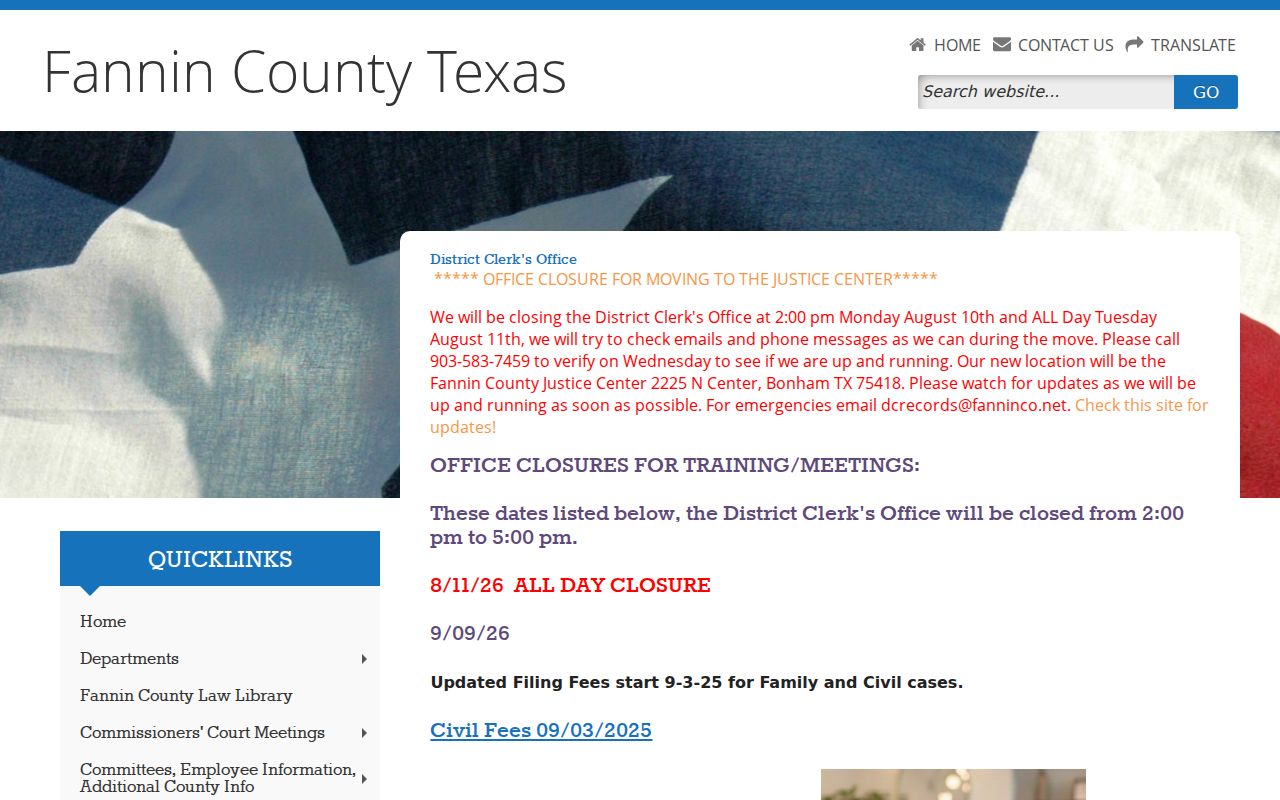
That official clerk channel is the right place to resolve a missing document, an archived file, or a need for certification.
How to Search Case Records
Begin with jurisdiction, not just a name. A broad name hit can combine people with similar names, while a cause number points to one prosecution. The Fannin Tyler portal is the county entry point for approved county and district information, but it was not reliably accessible during research. No unverified field labels should be assumed. Search what the live interface offers, record the court, cause number, status, and filing date, then verify the result with that court's clerk.
- Open the official county search page and follow its link to the Tyler public portal.
- Use the most exact identifier available, preferably a cause number; use a full name only when needed.
- Record the court, case status, filing date, and any displayed hearing or disposition data.
- Route a misdemeanor to the County Clerk and a felony to the District Clerk; search city or justice court records separately for fine-only matters.
- Ask the correct clerk for the actual docket or document and confirm any court date before acting on it.
The portal's verified search-field inventory is intentionally limited because the interface could not be inspected consistently.
| Verified portal element | Type | Use | Limit |
|---|---|---|---|
| County and district records | Public portal | Locate approved case information | Not every public record is online |
| Calendar information | Online display | Find a possible setting | Confirm directly with the court |
| Cause number and court | Result identifiers | Route a document request | Availability depends on the live result |
| Actual document | Clerk request | Read or certify the filed record | May require off-site retrieval |
Note: Fannin County says many records are stored off site, so call ahead and allow time for physical retrieval.
Fannin County Criminal Case Portal Limits
The Fannin Tyler public portal is a starting index, not proof that a search is complete. The county limits the web display to approved information. An older record may be off site, a new filing may not yet appear, or a fine-only case may sit with a court outside the county and district index. A searcher should save the identifying data from a hit and take it to the named custodian.
The portal source shows the official online entry point for Fannin County criminal case records.
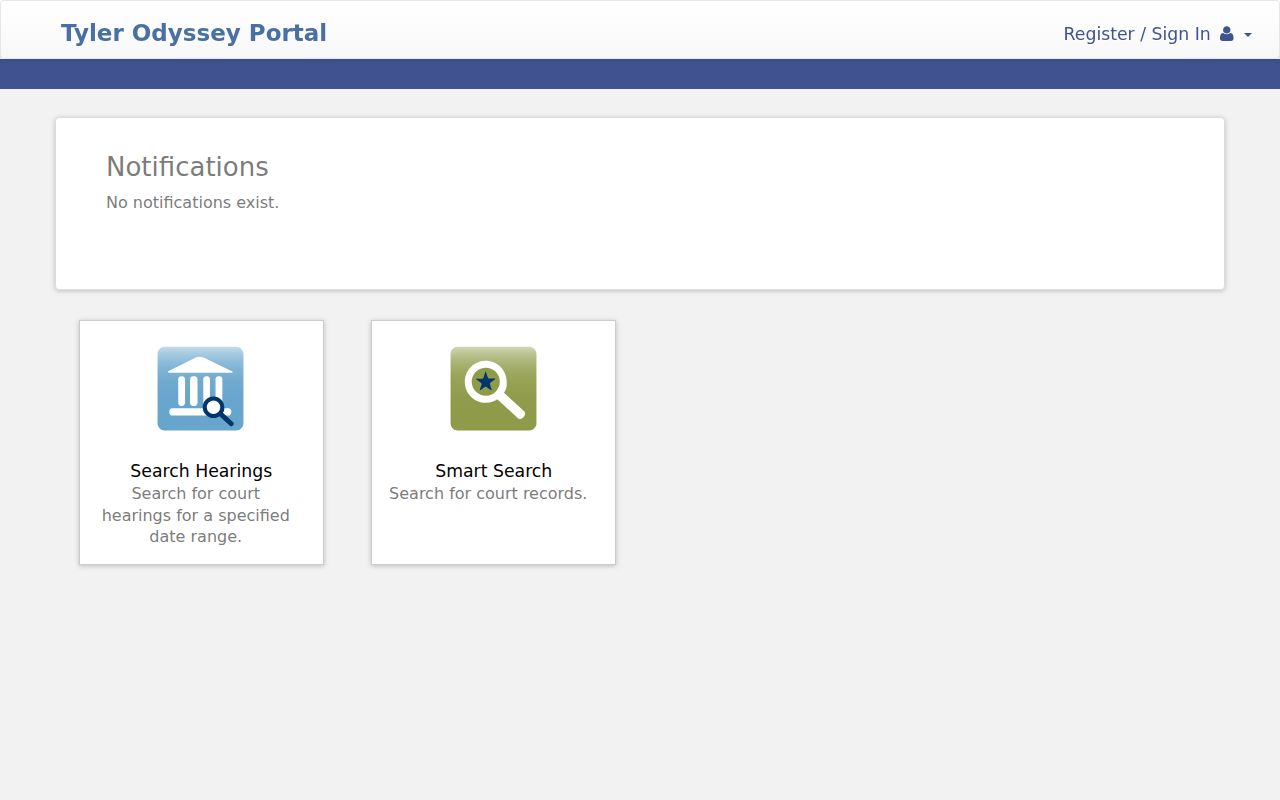
The follow-up clerk check matters most when a court date, final disposition, or certified copy will be relied upon.
What the Case File Shows
A court file is organized around one prosecution. It can show what charge the prosecutor filed, how the defendant responded, what motions or hearings occurred, and how the court resolved the matter. It may not contain every police narrative, booking detail, or statewide criminal-history segment. The specific items available depend on what was filed and what is public.
| Cause number and court | The unique case identifier and the court with jurisdiction. |
|---|---|
| Charging document | An information generally begins a misdemeanor; an indictment is the grand jury's felony charge. |
| Docket entries | The dated list of filings, appearances, motions, hearings, and orders. |
| Bond and warrant | Case-linked bond or warrant activity when filed in the court record. |
| Disposition and judgment | The outcome, such as dismissal, acquittal, conviction, or deferred adjudication. |
| Sentence and costs | Punishment, community supervision, restitution, fines, and court costs when ordered. |
A docket is the timeline, while the judgment is the formal outcome. Deferred adjudication means the court delays a finding of guilt while supervision is completed. A no-bill means the grand jury did not indict; it is not the same document as a dismissal after filing.
Fannin County Misdemeanor Case Records
The County Clerk Criminal Department maintains Fannin County Class A and B misdemeanor cases. Its examples include DWI, theft by check, marijuana possession, criminal trespass, and tampering with government records. The department performs searches, maintains warrants and subpoenas, handles fines and costs, and reports dispositions to the Office of Court Administration and Texas DPS.
The County Clerk source depicts the official misdemeanor record channel for Fannin County criminal court cases.
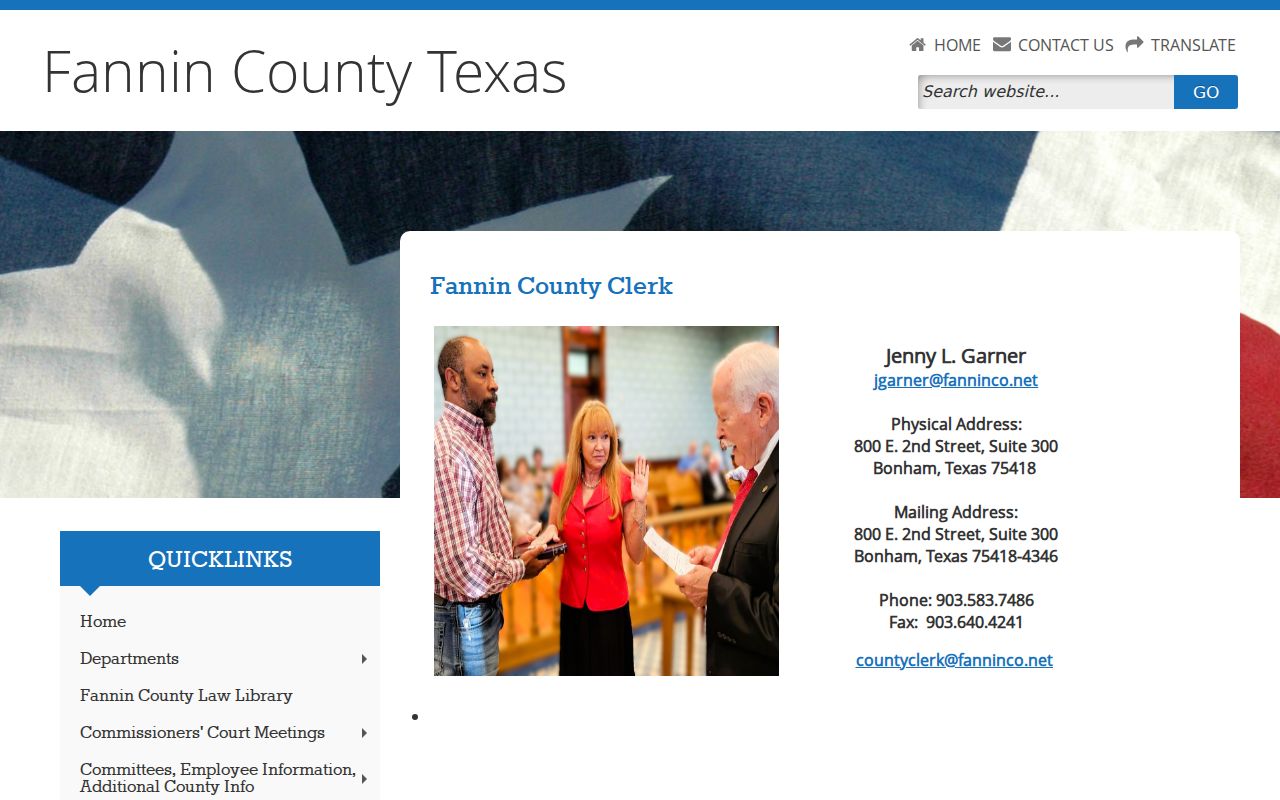
For a county-only Certificate of Search, the published fee is $10 per name. Be ready to supply the offense, offense date, and date of birth if known. The clerk is at 101 E. Sam Rayburn Drive, Suite 101, Bonham, and can be reached at 903-583-8502.
Note: The County Clerk expressly does not keep police reports, even when the report led to a misdemeanor prosecution.
Stages of a Criminal Case
The Fannin County Criminal District Attorney describes a local path that begins with an investigation or at-large referral. Prosecutors decide whether to file and may ask for more investigation. A misdemeanor normally proceeds by information. A felony normally goes to a twelve-member grand jury, where nine votes are needed to indict. A true bill results in an indictment; a no-bill declines one.
Case flow: Charges Filed › Arraignment › Pretrial › Plea or Trial › Disposition › Sentencing
The Fannin County criminal justice process explains motions, discovery, negotiated pleas, jury or bench trials, restitution, sentence, and appeal.
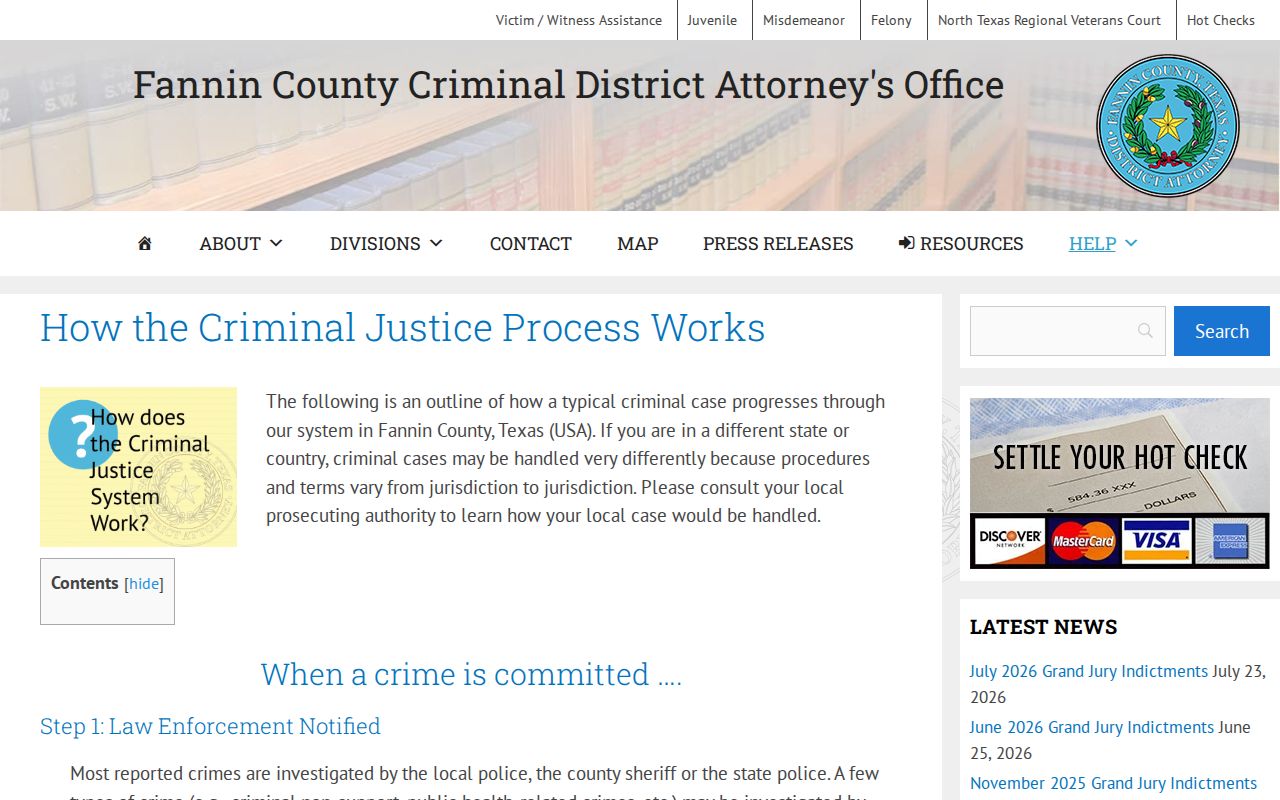
The sequence helps a reader place each docket entry in context. It also explains why an initial police recommendation may differ from the charge that prosecutors ultimately file.
Fannin County Fine-Only Case Routes
Fine-only records require a separate jurisdiction check. Fannin County has three justice courts: Precinct 1 in Bonham, Precinct 2 in Leonard, and Precinct 3 in Windom. A city citation may instead belong to a municipal court. Bonham Municipal Court, for example, keeps its own ordinance and fine-only matters. Searching only the county and district portal can therefore miss a valid lower-court file.
The correct route depends on which agency issued the citation and where it was filed. The official justice-court directory lists the three precinct offices. JP2 and JP3 warn that an online payment processes on the next business day and does not recall a warrant until posted unless the court receives confirmation. That operational lag matters to a person resolving an active case.
Ask the issuing agency or the cited court for the cause number. Then confirm status directly with the clerk before assuming a web payment changed a warrant or setting.
Fannin County Criminal Case Appeals
A judgment in County Court at Law or the 336th District Court can move to the Sixth Court of Appeals in Texarkana. A later criminal appeal may reach the Texas Court of Criminal Appeals. The trial clerk still holds the original Fannin County criminal case file, while the appellate court creates a separate docket for the review.
The 336th District Court source identifies the local felony court and its official records context.
When a local docket says an appeal was filed, note the appellate cause number and search that court's docket rather than expecting every later filing in the trial portal.
Access & Restrictions
Open court access does not make every detail public. Juvenile material, victim information, confidential identifiers, and records affected by a sealing, nondisclosure, or expunction order may be restricted or redacted. Active matters can also contain documents that are unavailable online even when the public docket exists. Courts are not ordinary Texas Public Information Act agencies for adjudicative case files, so the practical path is a request to the clerk who keeps the case.
Government Code Chapter 552 governs governmental information, while court case records retain access under other law and common-law principles. Government Code Chapter 411 controls criminal-history dissemination and nondisclosure. These bodies of law apply to different record systems.
If a case does not appear, give the clerk the name, approximate filing date, charge, and any cause number. Ask whether the file is archived, off site, restricted, or held by another court. Do not infer that an absent web result proves no prosecution existed.